

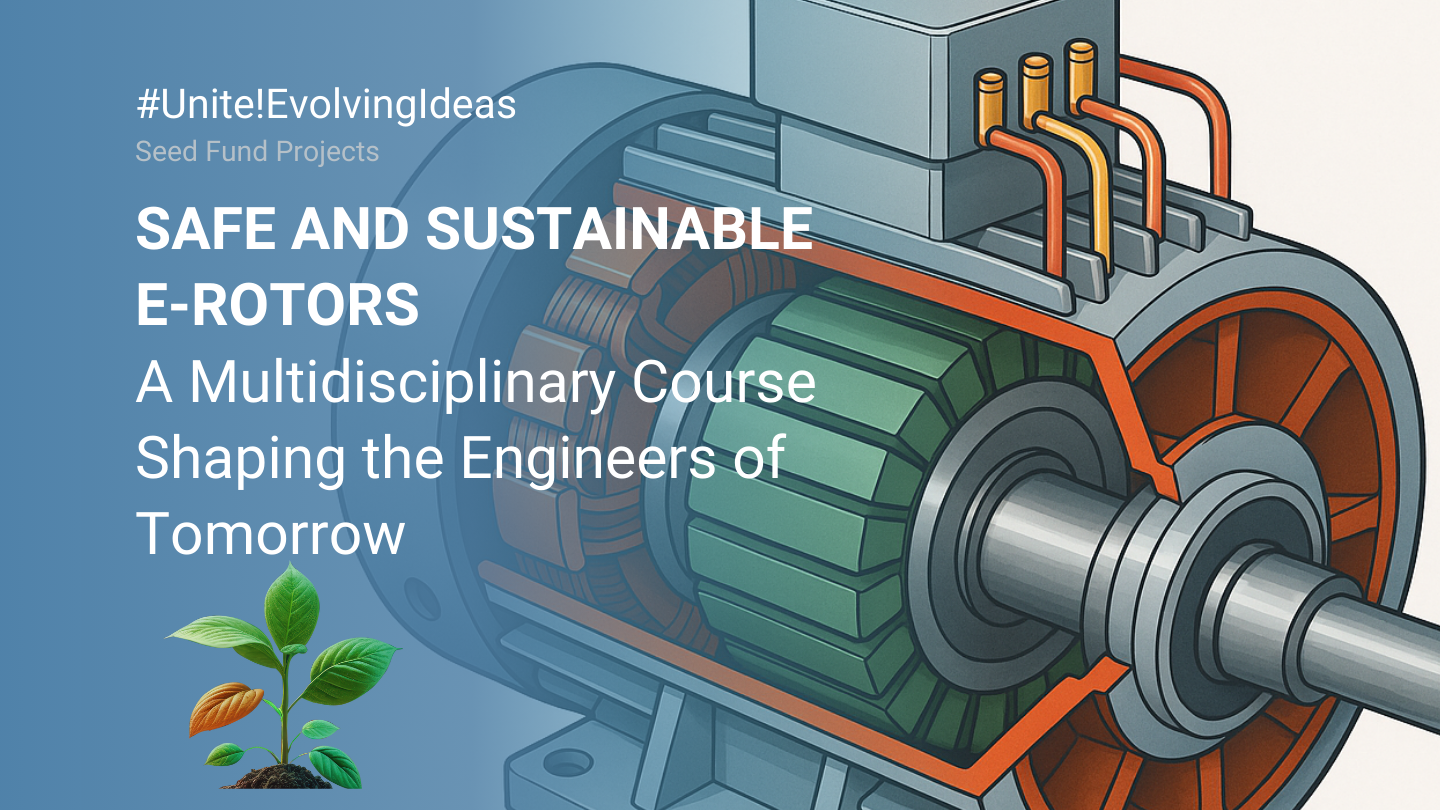
Safe and sustainable E-ROTORS: shaping the engineers of tomorrow
Six Unite! teams collaborate to create an innovative joint teaching module for masters' students revolved around the safety and sustainability of rotating systems.
The SAFE AND SUSTAINABLE E-ROTORS Project has received funding under the Unite! Seed Fund Initiative for Teaching & Learning.
The aim is to create a new teaching module to integrate competences of product development, system design, signal processing, diagnosis, AI, mechatronics and computer science, within Industry 5.0. This module will serve as the testing ground for integrating disciplines and will ultimately support the design of a new joint programme.
This project is part of the wider “thematic communities” initiative of the Unite! Doctoral School. These are networks of research groups and laboratories, working on cross-related research topics at partner universities. They support the orienteering of master students to doctoral education and contribute to cope with the lack of integrated courses in multidisciplinary domains such as Industry 4.0/5.0.
EU-ROTOR Lab community
The SAFE AND SUSTAINABLE E-ROTORS project stems from the “EU-Rotor Lab” community, whose members have experience in teaching machine design, rotor dynamics, applied mathematics, mechatronics and computer science in dedicated courses. However, a real integration among disciplines has not been consolidated yet, until now. From their collaboration, a new modular, thematic and experiential course will be offered in the academic year 2025-2026.
The course will confer 10 ECTs and will be a novel opportunity for masters’ students to learn about enabling technologies of Industry 4.0/5.0 through experimental activity, digital modelling, theoretical fundamentals data elaboration and analysis, covering even safety and cybersecurity issues. Students will be also introduced to industrial practices and will have the opportunity to co-design the joint programme.
“This activity promotes a multidisciplinary approach to system design, being based upon several competences, which support the enabling technologies of Industry 5.0. There, digital and ecological transitions meet sustainability and circular design. It is a learning-by-doing action, to involve students in accessing to experiments, retrieving data and then elaborating those results to become conscious interpreters of the cyber-physical systems behaviour. The EU-Rotor community provides a collaborative approach to teaching, by exploiting research skills and infrastructures of the Unite Partners as a scientific ecosystem”
Researchers and institutions
Eugenio Brusa, Full Professor, PoliTO (Coordinator)
Cristiana Delprete, Full Professor, PoliTO
Chiara Gastaldi, Associate Professor, PoliTO
Raine Viitala, Assistant Professor, Aalto
Sven Bossuyt, Associate Professor, Aalto
Stephan Rinderknecht, Full Professor, TU Darmstadt
Sidharth Dave, PhD Researcher,TU Darmstadt
Katrin Ellermann, Full Professor, TU Graz
Alexandre Presas, Full Professor, UPC
Luis Eduardo Mujica Delgado, Researcher, UPC
Agnieszka Wyłomańska, Full Professor, WUST
Michal Wozniak, Full Professor, WUST